










Cold storage continues to be a growing segment of industrial real estate. Demand for temperature-controlled space has grown faster than new construction in many markets. Growth is being driven by ecommerce grocery delivery, pharmaceutical distribution, food processing, and cold-chain logistics.
As demand grows, many owners, investors, and developers are looking at existing industrial buildings for cold storage conversion. Repurposing an existing building can be faster and less expensive than new construction. This is especially true in markets where industrial land is limited.
But cold storage is not simply warehousing that happens to be cold. Cold storage places structural, mechanical, and seismic demands on a building. Traditional warehouse operations may never encounter these conditions. Some of those demands are unique to cold storage, while others can significantly affect the scope and cost of a conversion.
Many industrial buildings can be converted to cold storage. The more important question is how extensive the required upgrades may be—and whether those upgrades align with the project’s goals and budget. The answer often depends on existing structural conditions that are not obvious until the building is evaluated.
What Makes Cold Storage Conversions Different?
Cold storage places unique demands on a building compared to traditional warehouse operations. Four of those demands set it apart, and each one carries structural consequences.
Roof Condensation
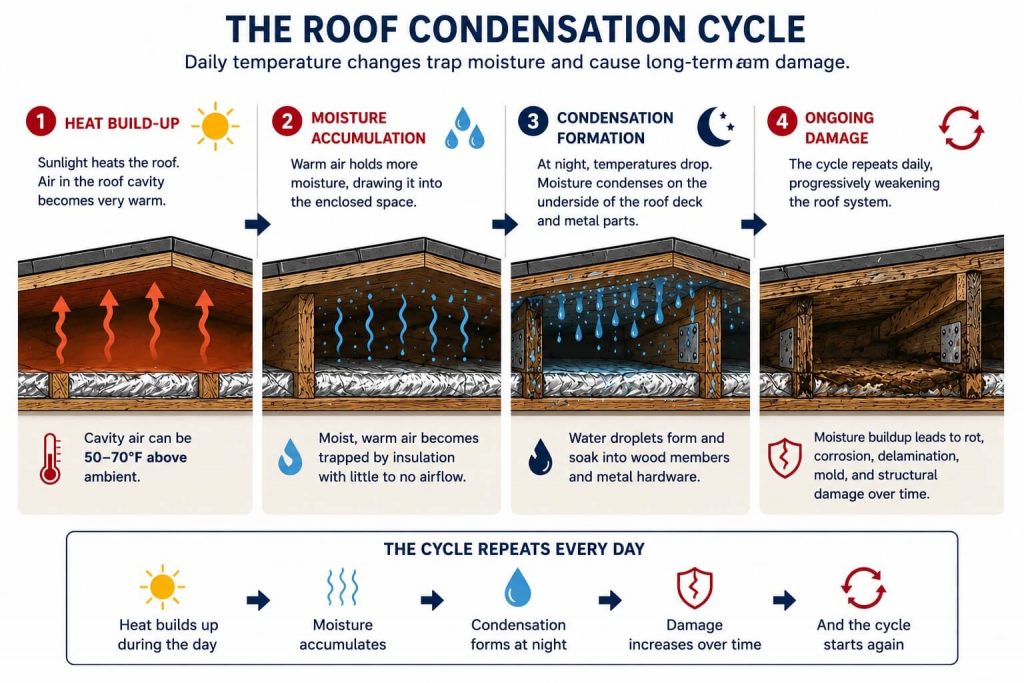
Roof condensation is one of the most common long-term challenges in refrigerated and freezer facilities. It develops when warm, moisture-laden air comes into contact with cold roof components.
If the roof is not properly insulated and detailed for cold storage use, trapped moisture can accumulate. Over time, it can contribute to wood deterioration, delamination, corrosion, and other structural damage.
Freezer facilities typically include insulated ceiling systems. Refrigerated spaces sometimes continue using the existing roof structure, increasing the potential for condensation-related problems if the roof assembly is not properly evaluated.
Understanding how the existing roof will perform under cold storage conditions is an important part of planning a successful conversion.
Roof Capacity
Refrigeration systems place substantial mechanical equipment on rooftops designed for much lighter loading conditions. Evaluating whether the existing roof structure can safely support that equipment is an important part of determining both the feasibility and layout of a conversion.
Because refrigeration equipment is often concentrated in specific areas of the roof, the building’s structural system should be evaluated to determine whether reinforcement or other modifications are needed.
For many older industrial buildings—particularly those constructed before 1997—this evaluation may also identify seismic upgrades that can be incorporated as part of the overall conversion project.
Existing Floor Systems
One consideration that is unique to many cold storage facilities is the floor system.
Freezer applications may require specialized slab and subgrade systems to help prevent frost-related movement beneath the floor, commonly known as frost heave. Existing industrial buildings were rarely designed with these systems in place. As a result, floor evaluation is an important part of assessing the feasibility of a cold storage conversion.
Not every cold storage conversion requires these upgrades. Refrigerated spaces can often continue using the existing concrete slab. Freezer applications typically require more extensive floor systems to support below-freezing conditions.
Depending on the intended use, floor modifications can represent a significant portion of the overall conversion budget.
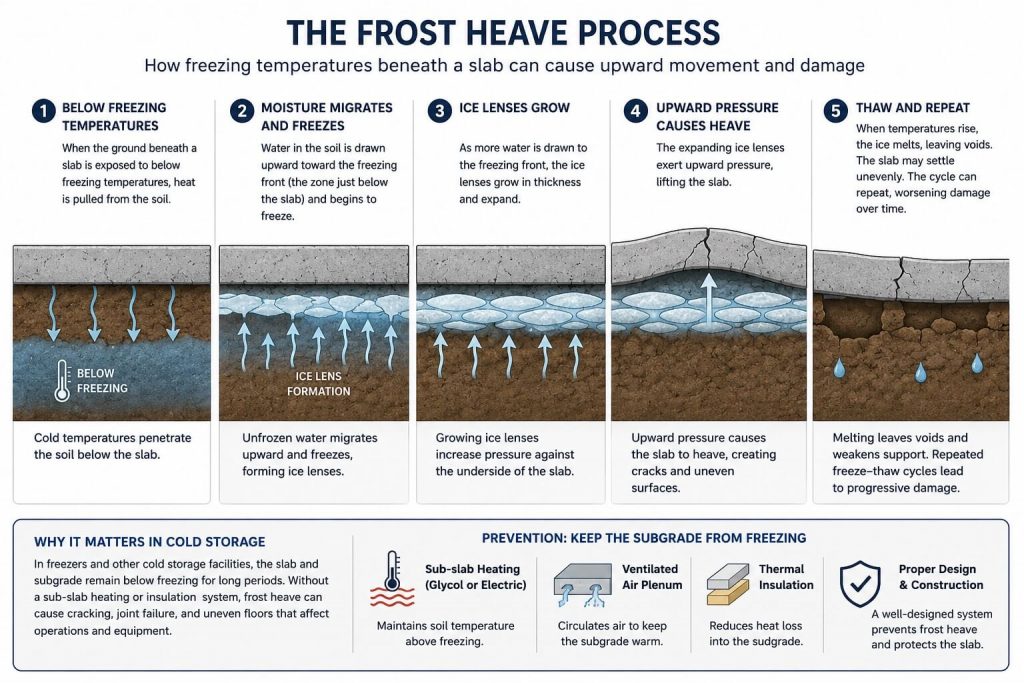
In freezers and other cold storage facilities, the slab and subgrade remain below freezing for long periods. Without a sub-slab heating or insulation system, frost heave can cause cracking, joint failure, and uneven floors that affect operations and equipment.
Building Envelope
Cold storage facilities require insulated wall and roof assemblies that help maintain consistent interior temperatures. Modern insulated panels are relatively lightweight. However, adding new envelope systems, refrigeration equipment, and other building components can change loading conditions and affect how the building’s structural and seismic systems perform together.
Why Seismic Performance Matters
For buildings in seismic regions, earthquake performance can be one of the most significant factors affecting the scope, schedule, and cost of a cold storage conversion.
As refrigeration equipment, roof loads, and storage systems are added, the building’s structural demands change. The building’s lateral force-resisting system (the structural framework that helps resist sideways earthquake forces) may have performed adequately for its original use. However, it should be reevaluated once the building is adapted for cold storage.
Continuous operations also raise the stakes. Damage to refrigeration equipment, piping, or structural systems during an earthquake can interrupt operations and affect temperature-sensitive inventory, making both structural performance and equipment protection important considerations.
Equipment Anchorage
Refrigeration equipment, piping, and mechanical components often require seismic anchorage and bracing to reduce the risk of movement or damage during an earthquake. Protecting these systems helps support both structural performance and continued facility operations.
Roof Diaphragms and Connections
The roof diaphragm acts as a large horizontal structural element. It collects earthquake forces and transfers them to the building’s lateral force-resisting system. Many older industrial buildings were designed under earlier seismic standards, and their roof diaphragms and connections may not meet current performance expectations.
When additional refrigeration equipment, insulation, and other building components are added, those existing systems may require further evaluation to determine whether strengthening or other upgrades are needed.
Existing Lateral Systems
Shear walls, braced frames, and other lateral force-resisting elements need to be evaluated against the building’s new, heavier-loaded condition, not the condition for which it was originally designed.
The extent of any required seismic improvements varies from building to building. In some projects, they represent a relatively small portion of the work. In others, they become one of the primary factors influencing project scope, schedule, and budget.
Common Structural Challenges Found During Building Evaluations
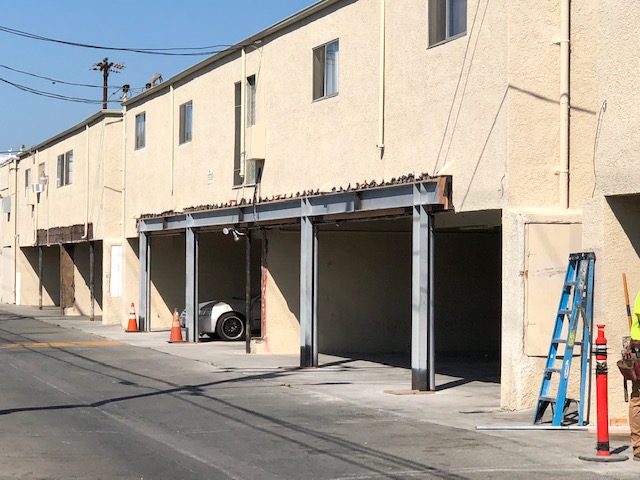
After evaluating and retrofitting thousands of commercial buildings, we’ve found that one of the most common discoveries is that existing field conditions do not always match the original drawings.
Years of tenant improvements, equipment installations, deferred maintenance, and undocumented structural modifications can significantly affect the design approach. They can also increase the project budget.
During a cold storage conversion evaluation, project teams frequently identify:
- Undocumented structural modifications
- Deferred maintenance or deterioration
- Roof capacity limitations
- Roof assembly conditions that may affect equipment support and condensation control
- Floor system conditions that may affect freezer applications
- Utility infrastructure constraints
- Seismic deficiencies requiring further evaluation
Identifying these conditions early provides owners with a clearer understanding of potential upgrade requirements before design and construction begin.
Why Similar Buildings Can Have Very Different Conversion Costs
Two industrial buildings with similar square footage can have dramatically different conversion costs.
One may have adequate roof capacity and floor systems that support the planned cold storage use. Its structural systems may require only modest upgrades. Another may need roof reinforcement, floor modifications, utility improvements, and seismic retrofits before it can support cold storage operations.
From the outside, the buildings may appear nearly identical. The difference often becomes apparent only after evaluating existing structural conditions.
Understanding those conditions early helps owners make informed acquisition decisions, develop more realistic project budgets, and reduce the likelihood of unexpected costs during cold storage conversion projects.
Not Every Building Is the Right Candidate
Some industrial buildings can be converted to cold storage with relatively modest upgrades. Others require structural and seismic retrofitting work significant enough to change whether the project makes sense at all.
Neither outcome is obvious from the outside. An early structural evaluation helps uncover those differences before major investment decisions are made.
The same logic applies to other industrial conversions—data centers in particular—where structural capacity, seismic performance, and upgrade cost all affect whether a project is feasible.
Planning a Cold Storage Conversion?
Before investing in design, construction, or equipment, it is worth understanding how your building’s existing structural and seismic systems may affect cost and feasibility. Every successful conversion starts with understanding the building itself.
Saunders Seismic helps owners, investors, and project teams evaluate existing industrial buildings. We help them plan for the structural, seismic, and budgeting considerations that influence successful cold storage conversions, data center projects, and other industrial building upgrades.
Contact Saunders Seismic to discuss your project and learn how early structural evaluation can support informed decisions before construction begins.