
Functional Recovery After an Earthquake: Why It Matters
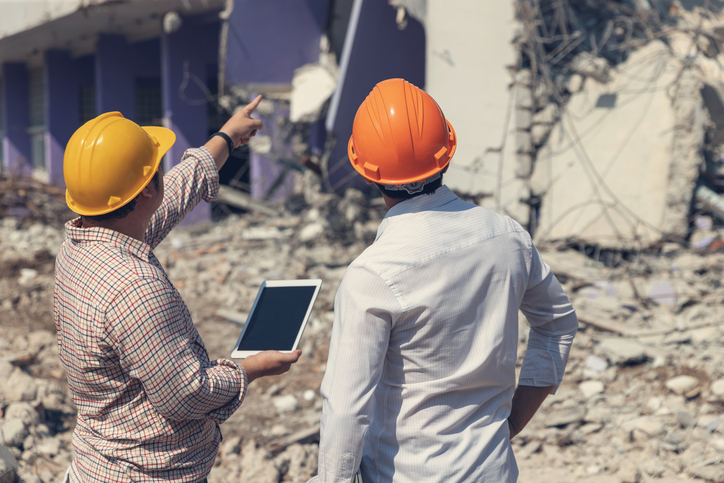
Functional recovery after an earthquake describes a building’s ability to resume essential operations within a reasonable timeframe—without requiring full reconstruction or extended closure.
In practical terms, functional recovery means a building is safe to occupy and can support most of its intended uses, even if some non-critical systems still need repair.
Engineers often describe it as a post-earthquake performance state: the space may not be fully restored, but it can safely support its basic purpose. As the concept gains traction nationwide, expectations around recovery timelines, usability, and cost are still evolving—creating uncertainty for many building owners.
Functional recovery lies between life safety and full restoration. In other words, it shifts the focus from survival alone to minimizing downtime, disruption, and displacement.
Functional Recovery vs. Life Safety
Most building codes prioritize life safety. Their primary goal is to prevent collapse and protect occupants during an earthquake. While that is essential, it still does not address what happens afterward.
A building can meet life-safety requirements and still be:
- Closed for months
- Too costly to repair
- Functionally obsolete
- Financially burdensome to owners and tenants
Life safety asks whether a building survives an earthquake.
Functional recovery asks how long it can afford to be offline.
This expands the conversation beyond “Will the building stand?” to “Can the building continue to operate?”
What Functional Recovery Is Not
Functional recovery is often misunderstood. It is not the same as:
Immediate Occupancy
Buildings designed for immediate occupancy can be used almost immediately after an event, with minimal interruption. Functional recovery allows for some downtime.
Immediate Recovery
This implies a full return to normal operations within days. Functional recovery recognizes that limited repairs and phased re-entry may be required.
Full Recovery
Full recovery restores a building to its exact pre-event condition. Functional recovery accepts that some systems may operate in a reduced or temporary state.
Prescriptive “Functionality” Code Provisions
Certain standards address functionality for specific building types, but they do not capture broader recovery objectives or business impacts.
Community Resilience
While related, community resilience focuses on cities and regions as a whole. Functional recovery applies at the individual building level, where owners make operational decisions.
Why Functional Recovery Matters for Building Owners
Most building codes are designed to protect life during an earthquake—not to ensure a building can be used afterward. As a result, many buildings remain standing but experience prolonged downtime due to damage, inspection requirements, or complex repairs.
A building can meet modern code requirements yet remain unusable after an earthquake.
Performance-based seismic research shows that buildings designed to minimum life-safety standards can sustain damage that prevents safe re-entry or disrupts essential building functions, even without collapse.
As a result, this gap between survival and usability is often where risk becomes real for building owners. Extended downtime commonly leads to:
- Lost revenue and interrupted operations
- Loss of clients during prolonged service disruptions
- Tenant displacement
- Delays tied to inspections and repairs
- Insurance or lender challenges
For many owners, the greatest earthquake risk isn’t collapse—it’s loss of function.
Older buildings—particularly those constructed before modern seismic design standards around 1978—often face longer recovery timelines (FEMA P-2090 / NIST SP-1254).
Functional recovery addresses this gap by focusing on how quickly a building can support people and operations after the shaking stops—not just whether it survives.
How Functional Recovery Supports Business Continuity
Functional recovery is closely tied to business continuity and disaster recovery planning—but it addresses a different part of the problem.
Business continuity plans typically focus on what an organization will do after a disruption, such as remote work, temporary relocation, phased reopening, or equipment replacement. Those plans often assume the building itself can support operations within a reasonable timeframe.
Whether that assumption holds depends on how the building performs after an earthquake. When a building survives an earthquake but cannot support power, access, equipment stability, or safe re-entry, operations pause—not because of planning failures, but because the structure cannot yet function as intended.
This is the middle ground many owners don’t anticipate: no collapse, no dramatic damage, but enough functional loss to halt operations.
The Economic Impact of Earthquake Downtime
Earthquake-related losses in the United States cost the nation an estimated $14.7 billion annually, driven not only by repair costs but by business interruption and extended closures.
In fact, in high-risk regions like California, downtime often exceeds direct repair costs—especially for commercial and industrial properties where operational disruption quickly compounds financial loss.
Functional recovery planning helps reduce this exposure by shortening the path from post-earthquake assessment to safe, usable space.
How Seismic Retrofits Support Functional Recovery
Functional recovery doesn’t happen by accident. Instead, it requires intentional planning and targeted upgrades that go beyond minimum life-safety requirements.
Seismic retrofits that support functional recovery may include:
- Strengthening primary structural systems
- Improving load paths and connections
- Addressing nonstructural vulnerabilities that often drive downtime, including equipment anchorage and bracing
- Coordinating retrofit design with operational priorities
- Sequencing construction to reduce business disruption
Planning for Recovery Starts Before the Earthquake
Functional recovery planning is most effective before an earthquake occurs—when options are clear and decisions aren’t rushed.
For more than 40 years, Saunders Seismic has helped commercial and industrial building owners like you understand earthquake risk in practical terms—not just code requirements.
We work alongside structural engineers to interpret performance objectives, align retrofit scope with real-world operational needs, and reduce uncertainty around cost, schedule, and outcomes.
The goal isn’t to create alarm. It’s to help you make informed decisions about how your building is likely to perform after the shaking stops—and what steps can meaningfully improve recovery.
If you’re evaluating seismic risk, weighing retrofit options, or simply trying to understand what recovery might realistically look like for your property, an early conversation can help bring clarity.
Have questions about your building? We’re here to talk it through with you. Contact us to start a free, no-pressure conversation.