
What Is a Seismic Retrofit? A Comprehensive Guide for Industrial & Commercial Buildings
What is a seismic retrofit? Many business owners have heard the term seismic retrofit, but many picture something far more invasive than what actually happens. Typical concerns include walls taken down to the studs, ceilings removed, entire floors closed, and tenant operations shut down for weeks.
In reality, typical seismic retrofits focus on strengthening the structural roof connections that keep your building intact during an earthquake—especially the connections between the roof and the walls. As far as operations are concerned, retrofits are mostly performed in occupied buildings with careful planning to limit tenant disruption.
This guide walks through what a seismic retrofit does, what the work looks like, and what to expect along the way.
Table of Contents
- What a Seismic Retrofit Actually Does
- The Seismic Retrofit Process
- The Two Most Important Parts of a Retrofit
- Why Some Buildings Need a Seismic Retrofit
- Do Seismic Retrofits Require Tearing Out Walls?
- Industrial vs. Office Buildings: What the Retrofit Actually Looks Like
- How Long Does a Seismic Retrofit Take?
- How Retrofits Affect Tenants and Daily Business
- What You’ll See During Construction
What a Seismic Retrofit Actually Does
A seismic retrofit strengthens the structural “frame” of your building so the walls, roof, and foundation move together instead of pulling apart during an earthquake.
Think of your building like a box:
- The walls are the sides
- The roof system is the lid
- he connections are the seams that keep it all together
Earthquakes push and pull the box.
Retrofitting reinforces these seams, so the box stays intact.
It’s much like an internal rubber band that wraps around the building and ties opposing walls together at regular intervals.
Most industrial and commercial retrofits do not involve rebuilding large areas of the structure. Instead, contractors:
- Strengthen weak connections
- Add anchors and ties
- Reinforce critical load paths
- Improve how forces travel through the building
- Locate and repair existing members that are failing due to loading or age
These targeted upgrades dramatically improve structural performance, usually with minimal impact to tenants.
The Seismic Retrofit Process
Step 1: Engineering Assessment (What the Engineer Is Actually Looking For)
A retrofit begins with a detailed structural assessment that identifies how the building currently handles seismic forces—and where that structural system breaks down. This evaluation gives engineers a clear picture of what must be strengthened to create a continuous, reliable load path.
During this phase, the engineer reviews:
Building type and layout
Different structures (tilt-up, CMU block, soft-story, irregular floorplates, re-entrant corners) respond differently to seismic forces. Identifying the type helps predict failure patterns.
Construction materials and framing sizes
Older buildings may have undersized wood members, weak nailing patterns, or concrete/masonry elements that cannot handle today’s lateral-force demands.
Existing roof-to-wall connections
Engineers check whether anchors are missing, spaced too far apart, deteriorated, or simply inadequate for modern seismic loads. These connections are common failure points.
Roof diaphragm condition
The roof acts as a horizontal brace, providing shear strength that stabilizes the building. Engineers determine whether it is strong enough to transfer seismic forces from the walls and foundations.
Wall, foundation, and load path conditions
Weak points such as cracked concrete, unreinforced walls, inadequate existing footings and wall ties, or discontinuous shear elements are documented.
Performance expectations (SEL/SUL context)
While not a full risk assessment, engineers consider how the building may perform during a scenario earthquake and what improvements would meaningfully reduce loss severity.
Outcome:
A detailed map of vulnerabilities that guides which retrofit techniques will strengthen the building without unnecessary invasive work.
Step 2: Retrofit Design
After identifying where the structure is vulnerable, engineers develop a building-specific retrofit plan. The goal is to create a continuous, predictable load path so that seismic forces can move through the building safely.
Common retrofits include:
Roof-to-wall anchors
Prevent separation between the roof and perimeter walls—a primary concern in older commercial buildings.
Continuity ties and drag struts
Connect disconnected segments of the roof or walls so the structure behaves as one unit rather than several independent parts.
Beyond normal retrofits, the following may be needed:
Moment frames
Installed around large openings (e.g., storefronts, warehouse roll-up doors) where solid shear walls are not feasible.
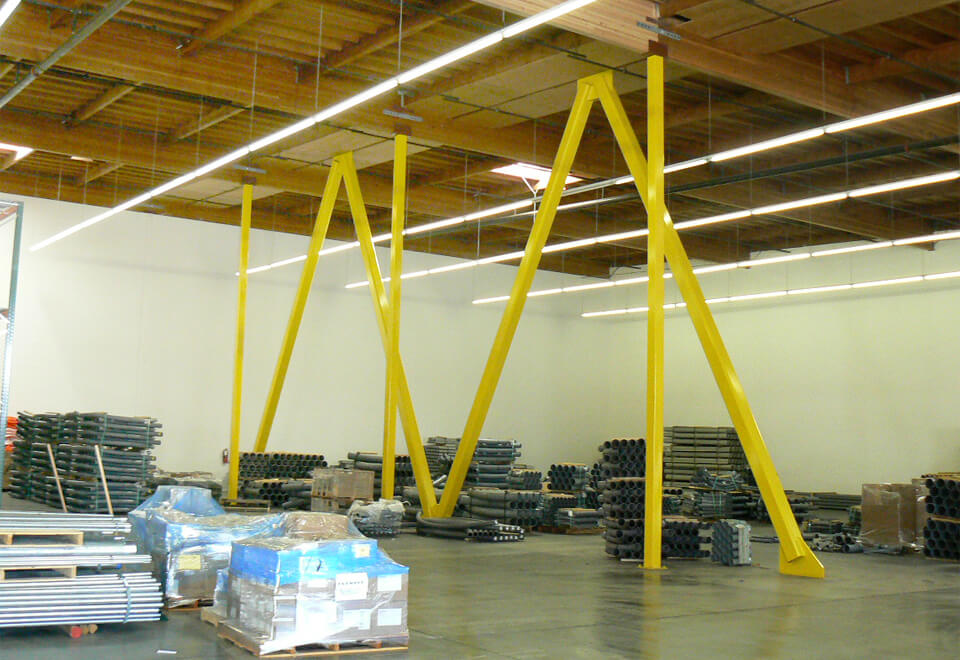
Steel bracing systems
Usually used for steel columns, bracing systems increase lateral stiffness and help control drift (side-to-side movement) during shaking.
Shear walls
Introduced or strengthened to absorb lateral loads and transfer them into the foundation.
Foundation bolting (common in residential/multi-family)
Keeps the structure tied to its foundation, reducing the risk of sliding.
Fiber Reinforced Polymer (FRP) systems
Applied to enhance the strength of concrete, masonry, or wood elements without adding significant weight.
Outcome: Each component strengthens a specific part of the load path, addressing the building’s structural weaknesses with targeted upgrades—rather than wholesale demolition or reconstruction.
For more detail on specific structural techniques, see our guide on How Seismic Retrofitting Strengthens Your Commercial Building.
Step 3: Construction & Implementation
Once plans are approved and permitted, construction crews implement the engineered design. Depending on the building type, this work may occur entirely at the roof level, within select wall areas, or at specific structural points.
During construction, crews focus on:
Precision and structural accuracy
Anchors, framing connections, welds, and reinforcement elements must be installed exactly as designed to perform correctly during an earthquake.
Compliance with code and engineering intent
Work is inspected throughout construction to ensure proper installation.
Maintaining building operations
Retrofit projects in commercial and industrial spaces often occur with tenants in place. Work is scheduled and staged to minimize impact on business activity.
Protecting interior finishes
When small openings in drywall or ceilings are necessary, they are limited to targeted areas and repaired once the structural work is complete.
Outcome:
A strengthened structural system with an improved load path, designed to reduce damage, protect occupants, and improve the building’s post-earthquake performance.
The Two Most Important Parts of a Retrofit
1. Strengthening the Roof System
The roof diaphragm acts like a giant horizontal brace. During an earthquake, it stabilizes the building’s perimeter walls.
Older buildings often have:
- Undersized wood members
- Inadequate nailing patterns
- Insufficient drag connections
- Framing that cannot handle modern seismic forces
Upgrades strengthen the roof so it can control movement during shaking.
2. Reinforcing Roof-to-Wall Connections
In many older buildings, existing roof-to-wall connections are inadequate or missing altogether. These connection points are among the most common failure locations during earthquakes.
During an earthquake:
- Heavy concrete or masonry walls push and pull as the building vibrates back and forth
- Anchors can fail, causing the roof to separate from the walls
- Walls can lean or collapse, leading to roof instability or failure
Retrofits add:
- Roof-to-wall anchors
- Continuity ties
- Collectors
- Drag connections
- Steel plates and hardware
These components keep the roof and walls attached so the building moves as one unit.
Why Some Buildings Need a Seismic Retrofit
Older commercial and industrial buildings were not designed to meet today’s seismic performance standards. Since building codes are updated every few years, these buildings may have structural conditions that increase their risk during an earthquake.
Common conditions that create risk include:
- Missing or outdated roof-to-wall anchors
- Undersized framing members
- Inadequate nailing or bolting patterns
- Long wall spans without lateral support
- Re-entrant corners that concentrate stress
- Unreinforced concrete or masonry elements
- Roof systems that cannot transfer forces into the walls
These weaknesses interrupt the building’s load path— the route seismic forces must follow safely through the structure. A retrofit restores this continuity so the building moves as a single, unified system during an earthquake, rather than having walls move independently or in opposing directions.
Do Seismic Retrofits Require Tearing Out Walls? (Short Answer: No.)
While every building is different, most retrofits:
- Do not require taking entire walls down to the studs
- Do not require removing ceilings across whole floors
- Are targeted to specific structural points
- Have limited, controlled openings where needed
Openings are restored with matched finishes, and most projects allow businesses to remain operational throughout construction. Most owners and property managers are surprised by how little of their finished space is actually affected.
Industrial vs. Office Buildings: What the Retrofit Actually Looks Like
Industrial / Warehouse Buildings
Retrofits are often faster and less intrusive because:
- Structural framing is usually exposed
- Fewer finishes need to be removed
- Restorative repairs are minimal or nonexistent
- Work can be done from lifts without affecting tenants
These buildings typically require:
- Installing roof-to-wall anchors
- Adding continuity ties
- Reinforcing drag lines
- Upgrading roof connections
Office and Multi-Tenant Buildings
Retrofits here may require:
- Going through office ceilings
- Coordinated scheduling around tenants
- Patching and repainting
- Small sections of drywall removal
But even in offices, retrofits are targeted—not full demolition. Crews open only the exact areas required to access structural elements. The difference is not whether a retrofit is feasible–it’s how carefully the work is sequenced and coordinated.
How Long Does a Seismic Retrofit Take?
Timelines vary widely based on building size, layout, access, and the type of retrofit being performed. In general:
- Small commercial spaces or single-story buildings: a few weeks
- Large industrial/warehouse buildings: several weeks to a few months
- Office interiors: depends on finish access and tenant coordination
Retrofits are typically completed in phases, allowing businesses to continue operating with minimal interruption.
How Retrofits Affect Tenants and Daily Business
Most seismic retrofits occur with tenants in place. Experienced seismic contractors typically:
- Schedule work around business hours when needed
- Section off safe, limited work zones
- Use temporary protection to keep areas clean
- Maintain open access for employees and customers
- Communicate clearly about what to expect each day
Retrofits are designed to be as unobtrusive as possible, especially in occupied buildings.
What You’ll See During Construction
Most business owners appreciate knowing what the work will look like. A typical construction phase includes:
- Crews accessing the roof system
- Small openings cut along perimeter walls (if interior access is needed)
- Installation of anchors, ties, and steel hardware elements
- Temporary protection for tenant spaces
- Drywall repair and finish matching
Work zones are carefully controlled, and only the areas required for structural access are opened.
Saunders Seismic: Strengthening the Buildings That Keep Your Business Running
If you have questions about what a retrofit looks like for your building, our team is here to provide clarity before you make any decisions. Seismic retrofitting involves complex structural work, and the quality of planning and execution is critical to minimizing disruption in active buildings.
Please note that seismic retrofitting requires a level of structural understanding and seismic focus that not all general contractors possess.
With over four decades of experience, Saunders Seismic specializes in commercial and industrial retrofits, structural repairs, and occupied construction across California, Oregon, Washington, Nevada, and Utah.
Contact us today with your retrofit questions.